Thursday, October 2, 2008

Finished classification project

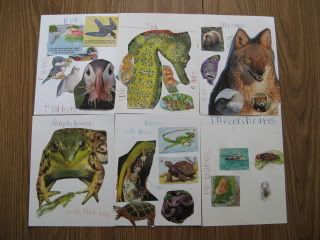
We finished our classification project last week. I put each collage into a sheet protector and made them our title pages for the respective sections of our nature commonplace book. Each section corresponds to a section in the Handbook of Nature Study.
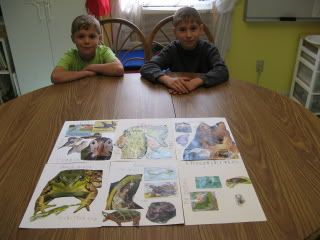
I even found an online classification game that the kids had fun with. They are excited about their new knowledge and wanting to apply it whenever possible.

Curiously, I found this quote in Comstock's book:

Nature-study does not start out with classification given in books, but in the end it builds up in the child's mind a classification which is based on fundamental knowledge; it is a classification like that evolved by the first naturalists, because it is built on careful personal observation of both form and life. (p. 6)

My friend is teaching Mammal Menagerie for our co-op, a program she got from a relative that works for the public school system. It comes with a video, newspapers, and other activities. One of the first things ds#2 did was to place a list of mammals into their appropriate Orders. This did not have the same appeal at all as our basic classification activity did. The kids found it interesting, though, that our large animal encyclopedia was organized by kingdom, then phylum, then class, and then order. That made it easy to find what we were looking for and the kids had fun seeing what other mammals were in each order.

To me, that was the key take-home message--that classification is a way to group all living things and that this system is used even in the books in our home. To be required to learn the various mammal orders demonstrates the point about "book" classification, and about "stuffing facts" into kids. How much more meaningful it is to discover these things through our own observations.

Saturday, September 27, 2008

Comparing microscopes offered at Homeschool Buyer's Co-op


First let me mention Homeschool Buyer's Co-op. They arrange group discounts from various companies for their members, and membership is free. Discount amounts go up as more members purchase a product.


They have a lot of science offerings, some of which have purchased.


Currently they are offering discounts on several Bolden microscopes through October 13th. Only now that all of them have reached the maximum discount are they worth the price. Shipping is $15 per scope.


My First Lab Microscope, now down to $83, is comparable with Kids' Microscope at Home Science Tool for $95. No fine focus. The optics are O.K. (some of my biology students use this model.) It will do the trick.


The Premiere Student Microscope, now at $131, is comparable with Great Scope's SF3 for $149. The SF3 has fluorescent lighting but no coaxial focus ($179 for that option.) Bolden is also offering a cordless version with LED lighting now at $137.


The Premiere Advanced Student Microscope, now at $197, gets you the 100x oil immersion lens and a mechanical stage along with the coaxial focus nobs. Bargain Microscopes has a $175 model with the 100x lens, but without a mechanical stage (a very nice feature costing $25 at Home Science Tools) or coaxial nobs (makes little difference to me.) Bolden's LED cordless version is $203.


Next closest model is Great Scope's SF4 for $209 (+$10 shipping) with coaxial nobs and fluorescent lighting; add a mechanical stage and the price goes up to $248. Home Science Tool's comparable model is $240 with a mechanical stage and fluorescent lighting.

Sunday, September 21, 2008

Handbook of Nature Study

Many Charlotte Mason homeschoolers, especially those following Ambleside Online, know about this fabulous living science book. Handbook of Nature Study by Anna Botsford Comstock, at 887 pages, is an indispensable resource especially if you live in Eastern North America.

Handbook covers many common flora and fauna in the Eastern US. It also discusses how to teach nature studies and includes many interesting activities in each section. While this is certainly a teacher's resource more than a read aloud, Comstock is very interesting to read.

It is not very helpful for identifying backyard finds, but that is not what it is designed to do. Good nature study goes far beyond identification, and this book is rich in information about your finds.

You can download a free electronic copy or purchase a softcover copy through Rainbow Resource for around $20.

Saturday, September 13, 2008

Fantastic Contraption

This is one excellent interactive physics game called Fantastic Contraption.

The object of the game is to move a pink wheel from the blue design box to the pink goal box by building your own fantastic contraption with only wheels and rods.

Be careful--you may find yourself spending a lot of time playing this one...

Thursday, September 11, 2008

Nature around the yard

My kids enjoy catching creatures that happen to enter our yard. We take the opportunity to examine and identify them. Simple lessons like these are the source of much learning.

This is a very small ringneck snake.

It is very easy to identify especially with the Snakes of Massachusetts site.


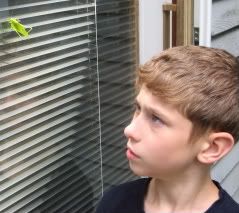
This is ds#1 staring at an enormous bug the kids saw sitting on our glass door.

It's a true katydid. I can't wait to show them the picture in the guide tomorrow.


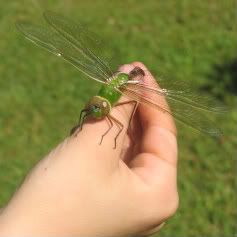
We have many dragonflies in the yard (they eat mosquitoes so they are both beautiful and helpful) and my kids love to catch them by their tails. The large ones are tough because they are fast, but ds#1 was able to get a huge green one today.

After looking at the delicate wings and the large, powerful mouth parts, he let it fly off into the woods.